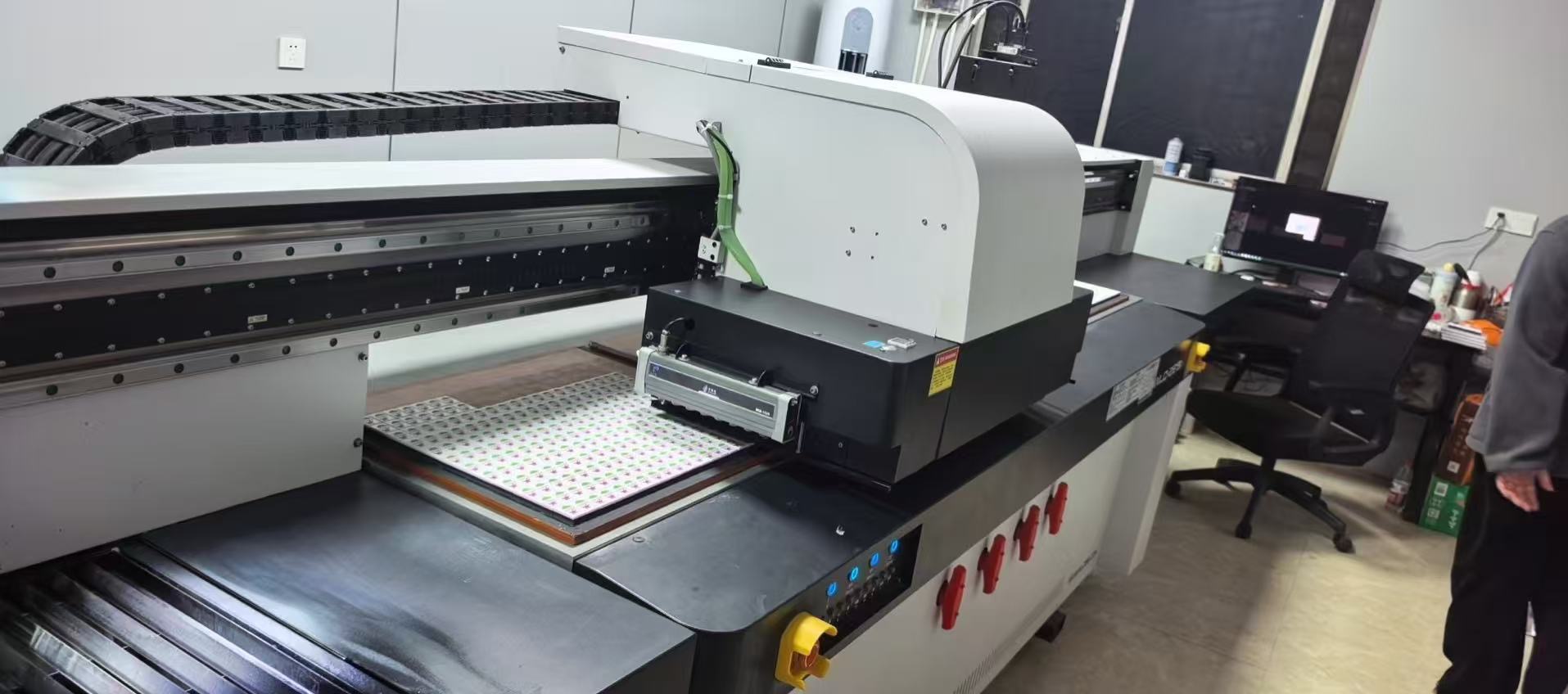
Direct answer: Use UV printing when the design depends on multiple colors, illustrations, gradients, or broad surface coverage. Use laser engraving when the design depends on recessed detail, a tactile mark, restrained line art, or a logo that should be defined by the tile surface itself. A custom Mahjong set can also combine the two: for example, UV-printed tile faces with a laser-engraved back logo. The final choice should be approved on the actual tile material, layer construction, colors, and finish.
UV printing vs. laser engraving at a glance
| Decision point | UV printing | Laser engraving |
|---|---|---|
| How the artwork is formed | Colored ink is applied and cured on the tile surface | The laser marks or removes a controlled area of the tile surface |
| Strong starting use | Multicolor suits, detailed illustrations, gradients, color-coded flowers or jokers, and repeating back patterns | Recessed logos, line art, lettering, tactile symbols, and restrained monochrome designs |
| Color capability | Supports multiple printed colors, subject to artwork, ink, surface, and sample review | The visible result comes mainly from the engraved surface and its contrast with the tile body |
| Surface feel | Usually keeps the tile profile largely flat, although printed coverage can still be felt depending on the process | Creates a recessed or etched area whose depth and texture must be approved |
| Main design risk | Color shift, weak opacity, registration problems, small-detail loss, or printed areas that are vulnerable in the chosen pack-out | Lines that are too fine, insufficient contrast, inconsistent depth, roughness, haze, or loss of small detail |
| Sample focus | Color direction, opacity, centering, registration, edge quality, and agreed handling checks | Depth, line clarity, contrast, edge cleanliness, surface feel, and consistency across duplicate tiles |
| Quote inputs | Number of colors, coverage, surfaces, unique files, tile material, layer colors, and quantity | Engraved area, line density, surfaces, unique files, tile material, depth direction, and quantity |
This table is a starting point. The same artwork can behave differently on ivory, transparent, pearlescent, jelly-color, dark, or multi-layer tile bodies. A production-ready decision therefore needs both a digital artwork review and a physical sample.
What UV printing is best suited to
UV printing is the natural starting point when color carries product meaning. It can support a full visual system across Dots, Bams, Craks, Winds, Dragons, Flowers, Jokers, blanks, backs, and matching packaging.
Consider UV printing when the project uses:
- several colors within one tile face;
- original illustrations rather than simple line symbols;
- gradients, texture, or detailed decorative fields;
- color-coded suits, Flowers, Jokers, or replacement tiles;
- a centered logo or repeating back pattern in brand colors;
- coordinated artwork across tiles, a Mahjong mat, inserts, and retail packaging; or
- an inner printed layer or another project-specific printed effect that the supplier has confirmed as feasible.
The buyer should not approve UV printing from an RGB screen preview alone. Tile color, transparency, pearlescent effects, surface gloss, printed opacity, lighting, and surrounding colors can all change the perceived result. Use the digital mockup to approve layout and use the physical sample to approve the production direction.
UV-printing questions to resolve before sampling
Ask the supplier to confirm:
- which tile surfaces will be printed;
- whether the artwork is centered, repeated, or edge-to-edge within a defined print area;
- the color-reference method used for the project;
- whether a transparent or dark tile layer needs an opacity adjustment;
- the smallest practical line, gap, and text size for the selected process;
- whether white, very light colors, gradients, or fine outlines need artwork changes;
- how front and back orientation will be controlled;
- whether duplicate tiles will be checked for consistent placement; and
- which handling, adhesion, or abrasion checks are included in the agreed sample and QC scope.
Do not describe printed artwork as universally scratch-proof or fade-proof. Performance depends on the ink system, surface preparation, tile material, coverage, handling, packaging, cleaning method, and written test requirement. Approve the intended use and evidence rather than relying on a blanket durability phrase.
What laser engraving is best suited to
Laser engraving is the natural starting point when the design should be defined through the tile surface. It is often appropriate for a back logo, simple lettering, a tactile icon, restrained line art, or symbols that do not depend on multiple printed colors.
Consider laser engraving when the project uses:
- a recessed brand mark on the tile back;
- single-color line art or typography;
- a tactile detail that should be felt as well as seen;
- a minimal visual system where the tile-body color provides the contrast;
- artwork that needs a defined engraved edge rather than broad printed coverage; or
- a combined construction in which engraving and UV printing serve different roles.
Laser engraving is not automatically the best process for every fine design. A line that looks precise at full size on a monitor can close up, lose contrast, or feel too rough when reduced to a Mahjong tile. Material, color, surface finish, artwork density, and engraving settings all affect the result.
Laser-engraving questions to resolve before sampling
Ask the supplier to confirm:
- the intended engraved surface and orientation;
- the practical minimum line width, gap, and text size;
- the target depth or tactile direction;
- whether the engraving will be left in the natural material appearance or use another confirmed treatment;
- how the design will contrast against the selected tile color;
- whether the material may show haze, heat effect, residue, or edge roughness;
- how engraving consistency will be checked across repeated copies; and
- whether cleaning or finishing after engraving is included in the process.
The sample should be reviewed both visually and by touch. Check that recessed details are intentional, readable, clean, and comfortable during normal handling.
When a combined process is the better specification
A brand does not need to force the entire set into one process. UV printing and laser engraving can be assigned to different artwork functions.
A combined process can make sense when:
- tile faces need full color but the back logo should be recessed;
- engraved outlines provide structure while selected areas carry printed color;
- a premium back mark is paired with detailed illustrated Flowers or Jokers;
- the brand wants one process for gameplay information and another for identity; or
- packaging, racks, pushers, and tiles require different production methods within one coordinated bundle.
A combined process adds approval points. The quote and sample plan should identify which file, surface, and tile category uses which process. Do not use a general note such as “laser + UV” without an artwork map.
Match the process to the tile construction
Henry Mahjong reviews 1- to 4-layer tile directions, custom colors, transparent effects, pearlescent tones, UV printing, laser engraving, and optional inner artwork by project. The visible result depends on the whole construction, not only the top artwork file.
Before selecting the process, confirm:
- tile material;
- finished height, width, and thickness;
- number and order of layers;
- color of each visible layer;
- transparent, translucent, jelly-color, pearlescent, or solid effects;
- front and back surface finish;
- artwork location relative to the layers; and
- whether the selected case, tray, rack, or pusher will contact a printed surface.
For example, a pale printed color can appear different on an ivory body and a transparent body. A shallow engraved logo can be visible on one color but weak on another. A repeating back pattern may look balanced on a single-layer tile but visually crowded when several colored layers already create a strong border. These are sample decisions, not assumptions.
Use the custom Mahjong set specification and materials overview to organize the construction before releasing artwork.
Prepare artwork for the actual production process
A useful artwork package separates creative intent from production instructions. Include one controlled file set and one artwork map.
For every tile design
Provide:
- a unique file name or tile ID;
- the tile category and required copy count;
- front, back, or inner-artwork location;
- UV print, laser engraving, or combined-process instruction;
- centered or repeating placement;
- orientation reference;
- approved revision number; and
- notes for any artwork that differs from the rest of the set.
File preparation
Use editable vector artwork for logos, line art, text, and engraving whenever possible. Supply high-resolution raster artwork when the design genuinely requires photographic or painted detail. Keep fonts outlined or package the permitted font information according to the supplier’s workflow.
Also include:
- color references rather than only screen values;
- a full-color preview of every unique face and back;
- a black-and-white process preview for engraved artwork;
- safe-area and alignment notes;
- the intended background treatment;
- a list of buyer-owned or authorized assets; and
- one document identifying the final approved revision.
Do not rename files casually after sample approval. A repeat order should be tied to the same artwork IDs, material, color direction, dimensions, process, sample reference, and QC scope.
How to compare process samples correctly
A useful comparison sample controls the variables. If the buyer wants to compare UV printing with laser engraving, use the same tile body, color, dimensions, artwork scale, and viewing conditions wherever feasible.
Review the samples for:
- readability at normal playing distance;
- contrast under typical indoor lighting;
- color direction and opacity;
- centering and front-to-back orientation;
- fine-line and small-text reproduction;
- engraving depth and tactile comfort;
- surface cleanliness and unintended marks;
- consistency across duplicate tiles;
- interaction with trays, bags, racks, and other tiles; and
- the appearance of the complete set, not only one enlarged test tile.
Record the result as a written approval. Photographs are useful evidence, but they do not replace the approved physical reference when color, gloss, depth, texture, or transparency is commercially important. The broader sample and QC checklist can be used before bulk production.
Which process is the better starting point for common designs?
| Design direction | Better starting process | What still needs sample approval |
|---|---|---|
| Full-color illustrated tile faces | UV printing | Color, opacity, fine detail, centering, and handling performance |
| Minimal back logo on a solid tile | Laser engraving | Contrast, depth, clarity, and surface feel |
| Multicolor Flowers and Jokers with a restrained back mark | UV faces + engraved back | Process alignment, consistency, and complete-set appearance |
| Repeating brand pattern on the back | UV printing or another confirmed print method | Repeat scale, seams or edges, orientation, opacity, and wear points |
| Fine monochrome line symbols | Laser engraving or UV printing after feasibility review | Minimum line width, contrast, loss of detail, and tactile preference |
| Transparent or multi-layer visual effect | Project-specific | Interaction among artwork, layer colors, transparency, and lighting |
| Artwork that must match a mat and retail box | Usually UV printing for the color system, with engraving used selectively | Cross-material color direction and brand consistency |
The phrase “better starting process” is intentional. Final suitability depends on the actual design and sample.
What changes the quotation?
Printing and engraving cost cannot be compared from the process name alone. A useful quote considers:
- number of unique tile designs;
- total tile count and order quantity;
- front, back, and inner artwork surfaces;
- printed coverage and color complexity;
- engraving area and artwork density;
- material, dimensions, layer count, and tile colors;
- number of samples or process comparisons;
- packaging that may contact or protect decorated surfaces;
- accessory and mat artwork; and
- agreed QC, testing, and production-evidence requirements.
Read how custom Mahjong set pricing is built before comparing quotations from different suppliers.
Copy this printing and engraving RFQ block
Product: Custom American Mahjong set
Order quantity:
Tile count and exact manifest:
Tile material and dimensions:
Layer count and layer colors:
Front artwork process: UV / laser / combined / supplier review
Back artwork process: UV / laser / combined / supplier review
Inner artwork requirement, if any:
Number of unique front files:
Number of unique back files:
Centered or repeating placement:
Color references:
Minimum text or line details that must be preserved:
Desired engraved depth or tactile direction:
Sample comparison required:
Handling / adhesion / abrasion requirement, if specified:
Accessories and mat artwork:
Retail packaging and internal protection:
Delivery country and postal code:
Target date:
Files attached and revision number:
This information allows the supplier to identify production risks before the sample is made.
Frequently asked questions
Can one Mahjong set use both UV printing and laser engraving?
Yes. A set can use UV printing for multicolor faces and laser engraving for a back logo or another restrained detail. The specification should map each process to the correct files, surfaces, and tile categories.
Is laser engraving always more durable than UV printing?
No universal answer applies to every material, depth, ink system, surface, and use condition. Define the intended handling and packaging, then approve process-specific sample and QC criteria.
Which process is better for full-color Mahjong artwork?
UV printing is normally the stronger starting point for multicolor illustrations, gradients, and coordinated brand colors. Final color, opacity, detail, and surface performance still require physical sample approval.
Which process is better for a tactile logo?
Laser engraving is normally the stronger starting point because it creates a recessed or etched surface detail. The buyer should approve depth, contrast, cleanliness, and hand feel.
Can custom artwork be added to both the front and back of a tile?
Yes, subject to the material, layer construction, artwork, orientation, process, and sample review. Specify every decorated surface in the artwork map and quotation.
Are vector files required?
Vector files are strongly preferred for logos, text, line art, and engraving because they provide controlled paths and clean scaling. High-resolution raster files may be suitable for detailed printed illustrations when the supplier confirms the production setup.
Choose the process after the artwork and tile body are defined.
Use the 3D tile designer to organize the layer and color direction, then send the artwork map, process preference, quantity, packaging, and destination for feasibility review.