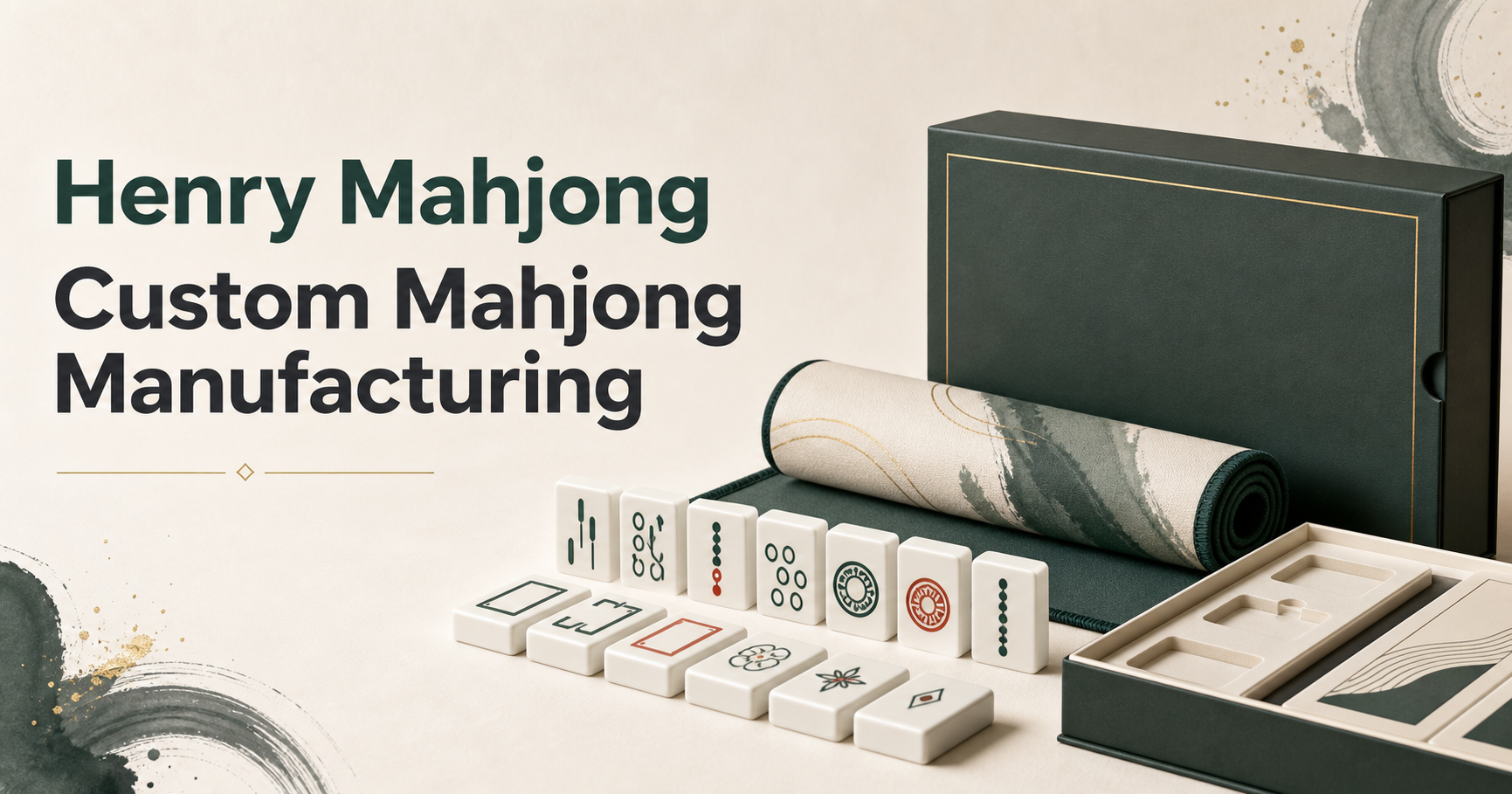
A useful custom Mahjong quotation starts with decisions, not only a logo. Before requesting a price, define the market, set configuration, construction, artwork, packaging, quantity, and delivery requirements. That gives the factory a stable basis for feasibility review and sampling.
1. Define the set configuration
State the intended market and tile count first. U.S.-market projects commonly use 160-tile or 166-tile configurations, while buyer-specified counts can be reviewed when the rules, replacement tiles, and accessories are clearly listed. Confirm whether racks, pushers, a mat, score accessories, or spare tiles belong in the same package.
2. Specify tile construction and dimensions
Choose a single-layer or layered direction and identify the preferred material and color effect. The Henry Mahjong online designer shows 1 to 4 layers. Its reference profiles include 36 × 24 × 11 mm for a single-layer tile and a 32 × 23 mm footprint for layered tiles. A 2-layer configuration can use 11 mm or 16 mm overall thickness; the 3- and 4-layer configurations use a 16 mm profile in the designer. Final dimensions are confirmed through the written specification and sample.
3. Prepare front and back artwork
Separate the face artwork, back artwork, and packaging files. Front artwork is normally centered. Back artwork can be centered or repeated, depending on the design. Send editable vector files when possible, and include color references, placement notes, and a list of any elements that must remain unchanged. All submitted artwork should be owned or authorized by the buyer.
4. Match the artwork to the production process
Laser engraving supports tactile recessed detail, while UV color printing supports multicolor graphics. Some projects combine both. Ask the supplier to confirm line thickness, small text, color coverage, registration, surface feel, and whether the design needs process adjustments before sampling.
5. Build the complete retail pack-out
Packaging affects unit cost, carton size, freight, and the customer experience. Define the inner organization, bag or case, rigid box or sleeve, instruction card, barcode or SKU label, insert, carton marks, and any matching mat or accessories. A visually attractive box that does not protect the tile weight is not a finished packaging specification.
6. Use the sample as the approval standard
Review dimensions, layer bonding, color, engraving depth, print clarity, edge feel, set completeness, packaging fit, and label accuracy. Record approved changes in writing. For repeat orders, keep a controlled specification that identifies the approved artwork version, materials, colors, package contents, and inspection points.
7. Send a quote-ready request
- Product market and tile count
- Order quantity; fully custom production starts at 200 sets
- Tile material, dimensions, layers, and colors
- Front, back, and packaging artwork status
- Production process and accessory list
- Packaging structure and labeling needs
- Delivery country, postal code, target date, and shipping preference
Prepare your custom set specification.
Use the 3D designer to organize the tile direction, then send the production details for feasibility review and quotation.