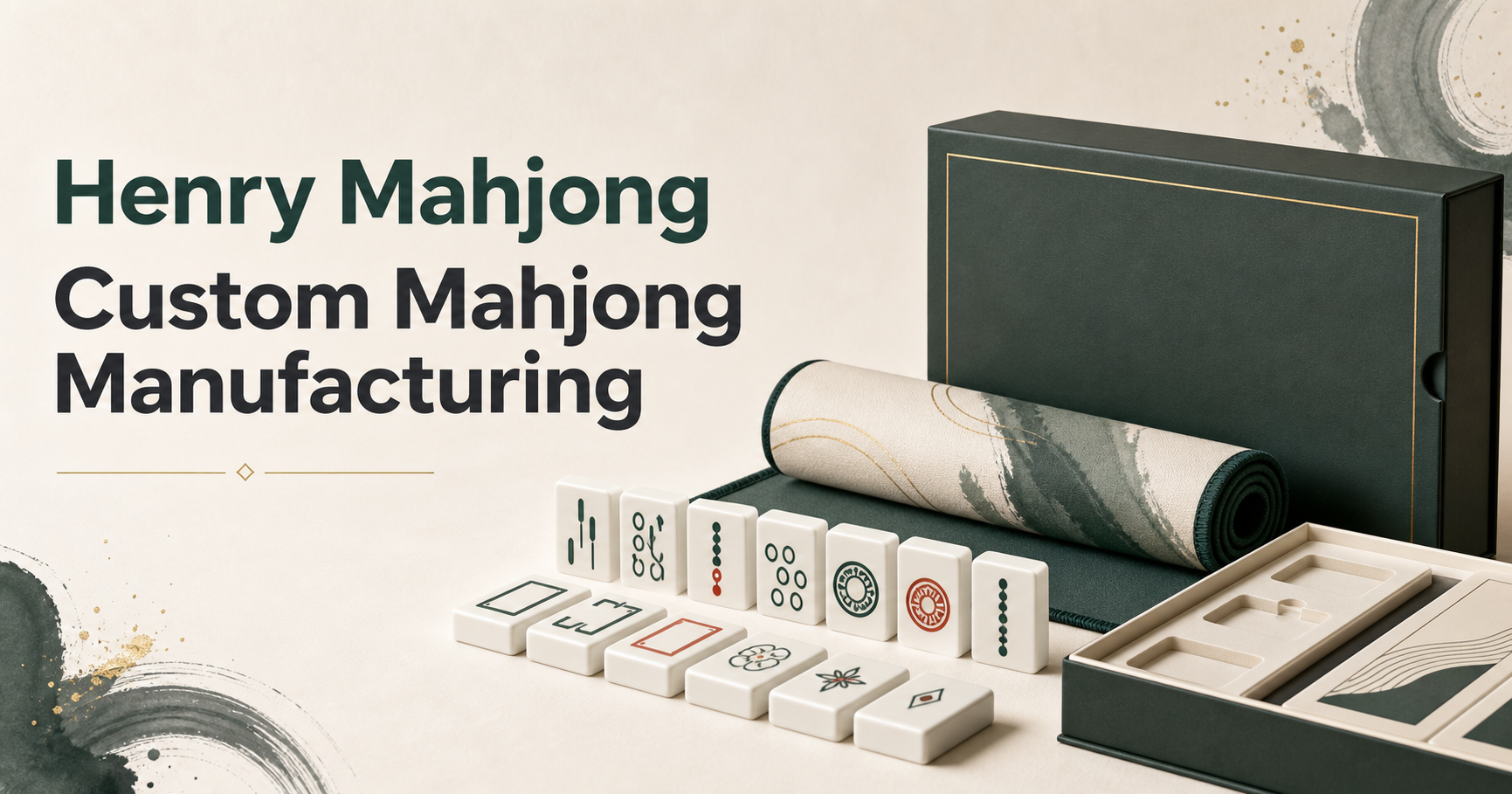
Direct answer: Use four simultaneous players per active table. Divide the maximum simultaneous player count by four and round up: that is the base number of playing sets. Plan one mat per active table when the organizer supplies the setup. Add a separate demonstration set for instruction or an operational spare only when the format, attendance, and replacement risk justify it; those extras are planning allowances, not official American Mahjong rules.
The quantity formula
Active tables = ceiling of simultaneous seated players ÷ 4.
Base playing sets = active tables.
Base organizer-supplied mats = active tables.
An Axios report on a Miami Mahjong series described registrations by individual or table of four, providing a current real-world example of the four-player event format. Your own floor plan, teaching method, rotation schedule, and guest-supplied inventory can change the operating allowance, but they do not change the arithmetic once simultaneous seats are known.
Quick planning table
| Simultaneous players | Active tables | Base playing sets | Base mats | Optional operating allowance |
|---|---|---|---|---|
| 4 | 1 | 1 | 1 | One demo set only if instruction must remain visible |
| 8 | 2 | 2 | 2 | One demo set for a structured beginner class |
| 12 | 3 | 3 | 3 | Demo set; consider one spare for recurring public use |
| 16 | 4 | 4 | 4 | Demo set and/or one spare based on the event plan |
| 20 | 5 | 5 | 5 | Demo set and/or one spare based on the event plan |
| 24 | 6 | 6 | 6 | Demo set and/or one spare based on the event plan |
| 32 | 8 | 8 | 8 | Demo set; one or two spares only if the risk supports them |
The final column is deliberately optional. A small private group may need no spare. A recurring paid program with tightly scheduled tables may value a sealed, count-checked backup. Record the assumption so a suggestion does not become an unexplained purchase requirement.
Two worked examples
Example 1: an 18-person beginner class
Eighteen simultaneous learners require five active tables because 18 ÷ 4 = 4.5 and the result is rounded up. The base is five playing sets and five mats. If the instructor needs a complete demonstration set that students will not use, stage six sets. Add another backup only if the organizer decides that interruption risk justifies it.
Example 2: 30 registrations split into two sessions
If 15 people play in each session, the maximum simultaneous count is 15—not 30. Four active tables, four base sets, and four base mats cover the seats. The same equipment can serve the second session if the schedule includes enough time to count tiles, reset accessories, inspect surfaces, and resolve missing components.
Do not count unconfirmed guest equipment
An Axios report about D.C.-area home Mahjong spaces noted that some hosts let guests bring their own sets. That can work for a private or member-led event, but a promised table should not depend on an unconfirmed contribution.
- List the owner, set reference, tile total, accessories, and arrival time for every guest-supplied set.
- Confirm that the configuration matches the event's selected American Mahjong format.
- Do not count “someone will probably bring one” as available capacity.
- Label organizer-owned sets and keep a before-and-after tile-count record.
Plan one complete table kit, not only one box of tiles
A base set count answers only the first question. For each active table, review:
- Tile manifest: exact 160, 166, or buyer-specified composition, including every Flower, Joker, blank, spare, and replacement tile.
- Playing surface: one measured mat or another confirmed surface, with enough usable table area for racks, walls, and hands.
- Accessories: racks, pushers, dice, indicators, bags, trays, and any teaching aids required by the organizer.
- Rules materials: current-year cards obtained through the appropriate issuer or authorized channel; do not reproduce protected card content as custom artwork without authorization.
- Operations: table number, set number, storage position, count sheet, cleaning method, replacement procedure, and person responsible.
Use the 160 vs. 166-tile specification guide before treating a total count as complete. Browse Mahjong accessories when deciding which components belong in every table kit.
Choose mat size from the actual table
Henry Mahjong's custom fabric-surface mats use an approximately 2–3 mm diatomaceous-earth composite backing and five square size references: 60, 80, 84, 90, and 100 cm. None should be presented as universal for every venue.
- Measure the usable tabletop, not the room or advertised table size.
- Allow space for players' arms, drinks, score materials, and anything that should remain outside the play area.
- Confirm whether the mat will be rolled, carried between venues, or stored flat.
- Choose unbound or bound edges after the artwork and handling plan are known.
Unbound custom mats can start from one, while custom solid-color edge binding starts at 200 mats. Final size, artwork, color, corners, edge treatment, packaging, and physical result remain subject to quotation and sample approval.
Match the sourcing route to the event stage
| Event stage | Set route | Mat route | Buyer control |
|---|---|---|---|
| First pilot or near-term event | Ready stock from one set, subject to availability and specification confirmation | Existing surfaces or unbound custom mats from one | Confirm every table kit before announcing capacity |
| Recurring class or club | Repeatable stock reference or documented custom specification | Measured, numbered mats with an agreed replacement route | Keep a set manifest, count sheet, and storage record |
| Branded fundraiser, corporate series, or venue program | Fully custom sets from 200 when original identity and scale justify development | Custom surface artwork; optional bound program from 200 | Approve artwork, sample, packaging, QC, and replenishment before launch |
Ready stock and custom production solve different timing and identity problems. The ready-stock vs. custom comparison explains the tradeoff without promising a fixed lead time before the current order is reviewed.
What a supplier should confirm after the count is known
Quantity is only useful when production and pack-out can be verified. Real workshop footage helps buyers ask about material handling, process checkpoints, inspection evidence, and packaging rather than relying on a generic factory claim.
Ask which sample, material, count, process, packing, and QC checkpoints apply to your own order. Review current workshop updates for additional real production references.
Copy this event equipment brief
Event / program name:
Rule variation and current card policy:
Total registrations:
Maximum simultaneous players:
Active tables (players ÷ 4, rounded up):
Base playing sets:
Organizer-supplied mats:
Instructor demonstration set: yes / no
Operational spare sets: 0 / 1 / other with reason
Guest-supplied sets confirmed:
Tile manifest: 160 / 166 / attached custom manifest
Mat size and usable tabletop measurement:
Racks, pushers, dice, indicators, bags, or trays:
Ready stock / fully custom / undecided:
Original or authorized artwork status:
Packaging and storage needs:
Delivery ZIP code / country:
Required event date:
Inspection and replacement plan:
Notes:
Frequently asked questions
How many players should one American Mahjong set serve?
Use four simultaneous players per active table for this planning method. Divide simultaneous seated players by four and round up to calculate the base number of playing sets.
How many Mahjong sets are needed for 20 players?
Twenty simultaneous players require five active tables and five base playing sets. A separate demonstration set or one operational spare may be useful depending on the event format, but neither is part of the base calculation or an official game rule.
Does every active table need a Mahjong mat?
For a consistent organizer-supplied setup, plan one mat per active table. Adjust only when the venue or registered players have confirmed which playing surfaces they will supply.
Should equipment be calculated from registrations or simultaneous players?
Calculate from the maximum number of people playing at the same time. Two scheduled sessions can reuse equipment if there is enough reset and inspection time between them.
Should an event use a 160- or 166-tile set?
Choose the total only after the organizer approves the exact tile-by-tile manifest. A 160- or 166-tile label does not by itself define every Flower, Joker, blank, spare, or replacement tile.
Can ready-stock sets work for a first club event?
Yes. Ready stock can support a small pilot or near-term event from one set, subject to current availability and exact specification confirmation. Fully custom production is more appropriate when original artwork, controlled packaging, and repeat-order identity justify a program starting at 200 sets.
Sources and planning limits
- Axios Miami: “Series brings mahjong trend on tour of Miami”, March 18, 2026; used for the observed individual/table-of-four registration format.
- Axios D.C.: “How to turn your D.C. home into a mahjong hub”, April 3, 2026; used for the guest-supplied-set and playing-surface examples.
- Axios Fort Lauderdale: “Mahjong is South Florida's new social night out”, August 17, 2026; used for current class, league, and venue context.
- National Mah Jongg League, current 2026 card notice reviewed August 25, 2026.
Planning limit: The calculation is transparent operational guidance, not an official league purchasing rule. Verify the organizer's rule variation, card policy, venue, schedule, equipment contributions, and approved product specification.
Send the table count, and receive a route-specific quote.
Tell us the maximum simultaneous players, exact tile manifest, base sets, mats, optional teaching or backup capacity, accessories, artwork, destination, and event date.